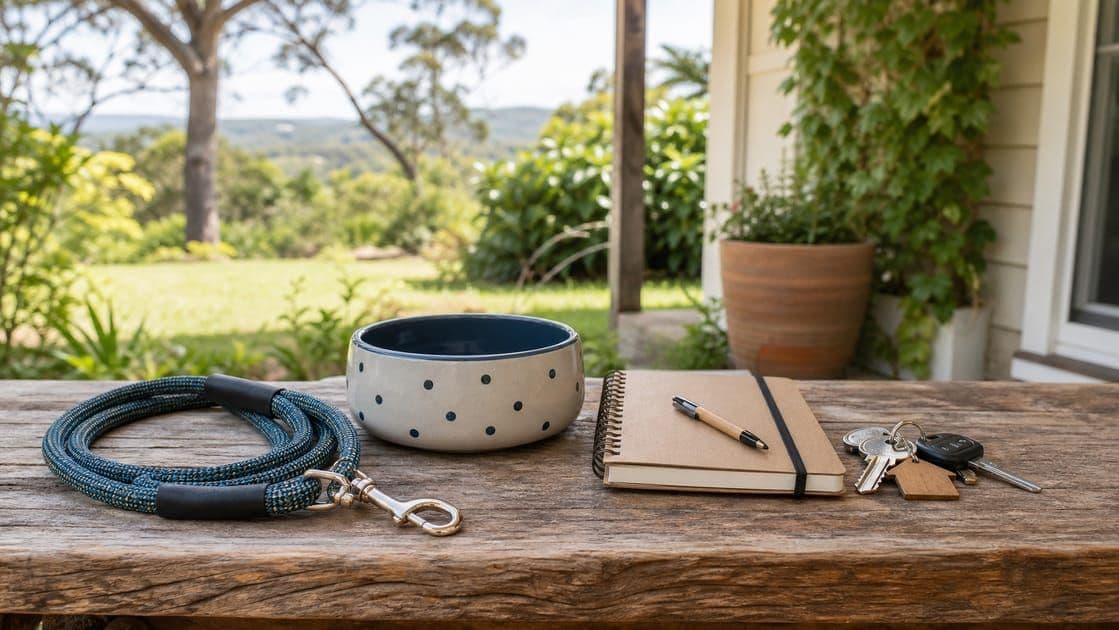
Pet care handover notes are two sheets. The first is your animal's day written in the order it happens: what time they eat and how much, every medication with its dose and its hour, walks and toilet routine. The second never changes, and carries the vet and insurance numbers, the vet spending authority, what normal looks like for this particular animal, and what to do when it is not normal. Write the day by the hour rather than by heading, because a sitter reads it at twenty to seven in the morning with a dog at their knee, not at a desk. The template is below, ready to copy.
Care notes are not the agreement. The agreement settles terms between two people, being dates, costs, access, vet authority and cancellation, and that page is covered in the Australian house sitting agreement. These notes cover the animal, hour by hour. Keeping them apart is what lets the agreement stay to one page and the care sheet stay useful.
Notes organised by heading fail at the moment they are needed
Most care sheets are written the way an owner thinks about their animal: Feeding, Medication, Walks, Emergencies. That is a filing system, not an instruction. The sitter's question is never "what is the feeding policy here". It is "it is twenty to seven, the dog is at the back door, what happens now". Someone reading category headings reassembles the morning from four places every day, and the item that gets dropped is the one that appears in only one of them.
A sit described as easy that turns out to be closer to full-time nursing is a handover problem before it is a listing problem. Writing the day out by the hour is the cheapest way to find out how much work you are actually asking for, while there is still time to say so in the listing. Our guide to what a house sitter is responsible for covers where the line usually sits.
The fixed page comes first, then the day
Three parts, in this order. The first never changes for the length of the sit, so write it once and keep it on its own sheet where the daily routine is not competing with phone numbers. The second is the day itself, and it gets a printed page of its own. The third is what normal looks like for this animal and the few exceptions worth planning for, which goes on the back of the fixed sheet.
| Field | What to write | Why this exact detail |
|---|---|---|
| Each animal | Name, species, breed, age, colour and markings, desexed or not, microchip number and the registry it sits on | Anyone reporting a found animal is asked for the number, not the nickname |
| A photograph of each animal | One clear recent photo with the animal's name under it | RSPCA emergency planning guidance asks owners to keep exactly this |
| Regular vet | Clinic, address, phone, opening hours, and the surname the file is under | The file is rarely under the animal's name |
| After-hours clinic | Name, address, phone, and the drive time from this house | Nobody researches this well at eleven at night |
| Pet insurance | Insurer, policy number, excess, and whether pre-approval is required | The sitter is the one standing at the counter |
| Vet spending authority | The figure the sitter may approve without reaching you, and who decides above it | Repeated from your agreement, because this is the page in their hand |
| People | Your mobile, your dates, your timezone, and one local person who can physically attend | A number in another timezone is not a plan on its own |
| Where the paperwork lives | Vaccination certificates, medical records and repeat scripts, in one place | Two of these get asked for at the emergency clinic |
Most of those rows come from RSPCA Australia's emergency planning guidance for pets, last updated 1 May 2024, which recommends a nominated emergency contact who can enter your home and care for the animal, photographs of your pets with their names, written instructions for treating any medical condition, and keeping the paperwork in a waterproof container with an electronic copy as well.
The microchip line is worth ten minutes before you leave. The RSPCA's guidance on microchip registries, last updated 24 November 2025, notes several databases running in Australia, two of them state government registries in New South Wales and South Australia, and says Pet Address searches a number of them and will redirect you to the database listing your animal's number if it is one of those it searches. The New South Wales and South Australian registries are also searched on their own sites, and where none of that turns the record up the RSPCA says to contact your vet or microchip implanter. Details two houses out of date are why a found dog takes far longer to come home than it should.
Write the day in the order it happens
One line per event, in time order, first thing to last. Two sentences a line is plenty.
| Time | What happens | The detail people leave out |
|---|---|---|
| 6.40am | Dog out to the yard, litter tray checked | The laundry door latch sticks, and the side gate is checked before the dog goes out |
| 7.00am | Breakfast for both animals | The amount in grams or cups, not "a scoop", and which bowl goes where |
| 7.15am | Morning medication, after food | The name as printed on the label, the dose, and where the container is kept |
| 8.00am | Walk | The usual route, on lead or off, how long, and what replaces it on a hot day |
| 9.00am to 4.00pm | Home alone | The longest stretch they are genuinely used to, in hours, and where they settle |
| 5.30pm | Second feed, then evening medication | Whether the two go together, and in what order |
| 7.00pm | Company | What they actually want, because this is the part a stranger cannot guess |
| 9.30pm | Last toilet, lock up, bed | Where each animal sleeps, and whether the bedroom door stays open |
Two rows carry more weight than they look. On amounts, the RSPCA's feeding guidance for dogs, last updated 21 August 2024, says adult dogs should be fed at least twice a day and that how much depends on size, breed, age and exercise, with your vet best placed to assess it. The number in your notes is therefore your vet's number for your animal, written down, not a general rule a sitter could look up.
On the walk, the hot day version is an Australian requirement rather than a nicety. RSPCA guidance on protecting dogs from heatstroke, last updated 8 May 2023, recommends exercising at the coolest times of day, warns that ground temperatures can be unsafe on concrete, asphalt, bare ground and even grass, and says never to leave a dog in a vehicle. A February sit in Mildura and a July sit in Ballarat are not the same walk.
The medication line is where handovers actually break
Three things belong on it and most notes carry two: the drug name as printed on the label, the dose, and what to do when a dose is refused or missed.
Ask your clinic for the directions in writing rather than relying on a demonstration at the front door. The Australian Veterinary Association's policy on veterinary prescribing rights states that veterinarians exercising those rights must provide adequate directions in writing and ensure they are made available to those administering the medicine. Your sitter is the person administering it, so that standard is theirs to receive. Ask for it by email and put a copy in the notes.
Never write a dose from memory
Copy the drug name, the strength and the dose from the label or from the written directions your vet supplied. A figure recalled at the front door on the morning you fly out is the most dangerous line in a care sheet.
Whether a particular sitter suits twice-daily injections or a post-surgical animal is a conversation to have before you confirm, not something a template fixes, and our guide to medication and post-surgery care during a sit works through it. This article is general information, not veterinary advice. Anything to do with your animal's health comes from the vet who treats them.
Three fields almost every care sheet leaves out
The first is what normal looks like. A sitter cannot tell you an animal seems off unless they know what Tuesday looked like.
| What to record | Write it like this |
|---|---|
| Appetite | Finishes breakfast in about five minutes and licks the bowl afterwards |
| Water | Empties the bowl roughly twice a day in summer, once in winter |
| Toilet | Two stools a day, usually on the morning walk |
| Sleep | On the second step from about ten, up again when the gate goes |
| Movement | Takes the back steps one at a time and has done since the knee surgery |
| Greeting | Meets you at the door every time. If she does not, something is up |
None of that is a diagnosis. It is what produces the sentence you want, "two things on your list changed today", early enough to matter, and the sitter then rings the clinic on the fixed page. Our guide to warning signs worth a vet visit is background reading, not a substitute for that call.
The second is the never list: what the animal must not eat, which gate is never left open, which dog to avoid on the corner, what happens to the front door when a parcel arrives. Short, blunt, written as prohibitions.
The third is company, which owners under-write because it does not feel like a task. The Australian Veterinary Association's policy on responsible ownership of dogs and cats describes dogs in particular, and cats bred as companions, as social animals requiring social interaction, and lists social requirements and enrichment alongside food and shelter. Give it a time and a line, the same as the feed.
Copy this, fill it in, keep it to two sheets
Replace anything in square brackets and delete what does not apply. There is also a printable, copyable version of this template on its own page.
Part one: the page that does not change
- Animals. [Name], [species and breed], [age], [colour and markings], desexed [yes or no], microchip [number] on [registry]. Photo attached.
- Vet. [Clinic], [address], [phone], open [hours], file under [surname].
- After hours. [Emergency clinic], [address], [phone], about [X] minutes away.
- Insurance. [Insurer], policy [number], excess $[amount], pre-approval [yes or no].
- Authority. The sitter may approve treatment up to $[amount] without reaching me. Above that, call [number]; if no answer within [X] minutes, [name] decides. All veterinary costs are mine.
- People. Me on [mobile], away [dates], in [place], [timezone]. Local contact [name], [number], [suburb], able to attend within [X] minutes.
- Paperwork. Certificates, records and repeat scripts are kept [location], copy in our message thread.
- Food. [Brand and variety], kept [location], [X] weeks' supply, from [shop]. Never feed: [list].
Part two: the day, hour by hour
- First thing. [Time]. [What happens]. Watch for [the latch, the gate, the cat at the door].
- Breakfast. [Time]. [Animal]: [amount] of [food] in [bowl], [where]. [Animal]: [amount] of [food], fed [together or separately].
- Morning medication. [Time]. [Name on the label], [dose], [before, with or after food], kept [location], given [method]. If refused or brought back up, [what your vet told you to do].
- Walk or outside time. [Time]. [Route or yard], [on lead or off], [X] minutes. Hot day version: [earlier time or indoor alternative].
- Alone. [Time] to [time]. Longest they are used to: [X] hours. They settle [where], with [radio, blinds, door left open].
- Second feed. [Time]. Amounts as above.
- Evening medication. [Time]. As above.
- Company. From [time], [brushing, a game in the hallway, the couch, a lap], about [X] minutes.
- Last thing. [Time]. [Toilet], [doors, windows, gates], [where each animal sleeps], bedroom door [open or shut].
Part three: normal, and the exceptions
This part goes on the back of the fixed sheet, so the day sheet stays clear. The last line uses the wording of the Australian Warning System, the national scale used for bushfire, flood, storm, extreme heat and severe weather warnings, on which Watch and Act is the middle level and means there is a heightened level of threat and you need to start taking action now. That is general information only. The site links every state and territory agency and tells readers to refer to their local agency for current warnings, so write this line to match what the agency covering your suburb advises.
- Normal. Appetite [X]. Water [X]. Toilet [X]. Sleep [X]. Movement [X]. Greeting [X]. Message me if two change on the same day.
- A hot day. Above [temperature] the walk moves to [time], they stay [where], with [fan, tiles, shade, extra water]. The car is not an option at any temperature.
- A storm or fireworks. They hide [where]. [What helps]. Shut [which door] first.
- Will not eat. Leave it [how long], then ring [clinic].
- If one gets out. Microchip [number] on [registry]. Ring [council] and [nearest pound], post to [local community page], tell me.
- A warning for this area. On a Watch and Act for [suburb], [what the sitter does]. Carriers and leads are [location]. Destination [address]. In a life-threatening emergency, call 000.
Print one, message one, and walk it through once
- Print the day sheet and tape it where the work happens, usually the fridge or the food container.
- Photograph the food container with the scoop sitting in it, the medication label, and the lead hook.
- Demonstrate the medication rather than describing it, and have the sitter do it once while you watch.
- Walk the route once together, including the gate that sticks and the corner where the other dog lives.
- Send the whole thing as a message too, so a page that falls behind the fridge is an inconvenience rather than a problem.
Keep a copy that cannot fall off the fridge
Paste the finished notes into your Sitterly message thread as well as printing them. You both end up holding the same timestamped copy, with no printer, no attachment and no e-signature service involved.
What does not belong in the care notes
- Terms. Dates, handover times, running costs and cancellation live in the house sitting agreement. Repeat only the vet spending ceiling here.
- The house. Bins, alarm codes, wifi, the pool and the plants belong in what to leave for a house sitter. Mixing them in is how a medication time ends up under bin night.
- Tasks nobody agreed to. Anything that would have changed the sitter's answer belongs in the listing, not the handover.
“Sitterly supports the connection. Homeowners and sitters remain responsible for their own arrangements.”
- Sitterly, About page
Common questions about pet care handover notes
- What should pet sitter instructions include?
- The animals and their microchip numbers, your regular vet and the after-hours clinic, insurance details and the vet spending limit, every medication with its dose and time, the day written by the hour from first thing to last, what normal looks like for each animal, and what to do on a hot day, in a storm, if an animal will not eat, or if one gets out.
- How long should pet care notes be?
- One printed page for the day, plus one more sheet printed back to back, with the numbers and paperwork on one side and what normal looks like and the exceptions on the other. Beyond that the parts that matter get skimmed. If your animal genuinely needs more than two sheets, say so in the listing, because you are asking for a different kind of sit.
- Do I need care notes for a two night sit?
- Yes, and they take about fifteen minutes. Feeding amounts, medication times, the vet numbers and the spending limit cause trouble at any length. The hour by hour part is shorter, not absent.
Write the day against a real sit
The notes fill themselves in once there are dates and a person on the other side of them. Post a listing on Sitterly, free for homeowners, and describe the day honestly in the listing rather than saving it for the handover. How Sitterly works sets out the steps, and you can read the open sits to see how other Australian homeowners have described theirs.