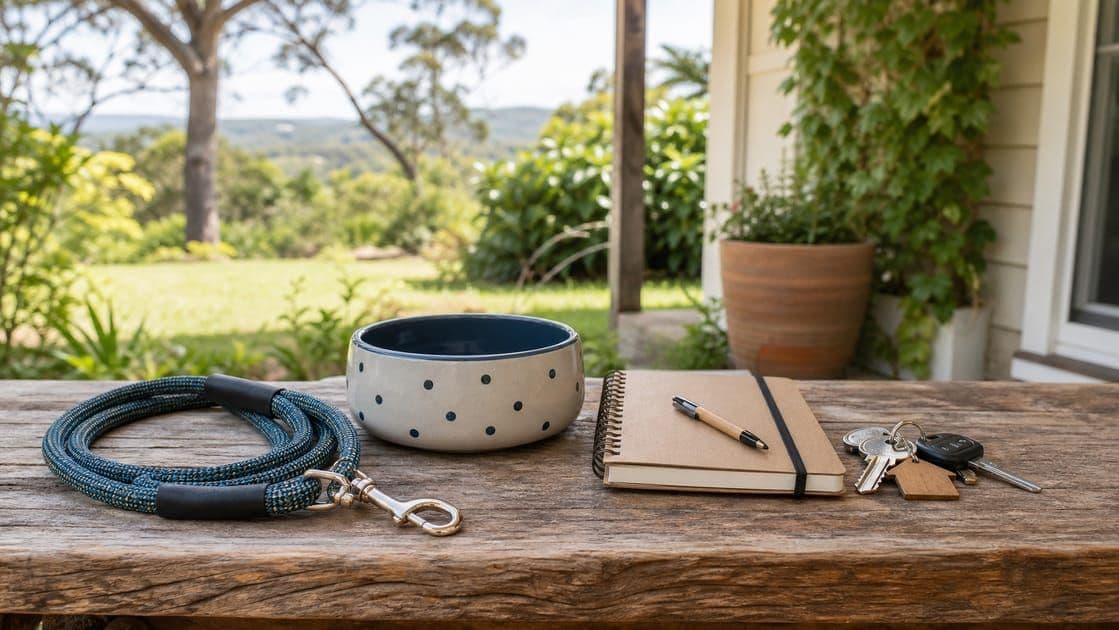
Leave a house sitter three things: written notes they can read at 3am without ringing you, supplies for the whole stay plus about three days, and the local knowledge that currently exists only in your head. The third group is what an international checklist never mentions and what decides how an Australian sit goes: which night the bins go out and which bin, where the after hours vet is and how long the drive takes, what to do on a total fire ban or a flood watch, whether the dog can find the pool steps, and which months bring snakes and paralysis ticks to your street.
None of it is about distrust. It is about the fact that a stranger cannot see what you have stopped noticing.
Write it down and print it, because a message thread is useless at 2am
Someone working out at 2am whether vomiting twice is normal for your dog should not be scrolling eleven days of chat with your phone off in another time zone. Paper on the bench wins, and photographing each page into the thread afterwards gives you both a dated copy.
| Document | What it settles | Where to leave it |
|---|---|---|
| Pet care sheet | Food in measured amounts, medication doses and times, exercise, and what normal looks like as well as what a bad sign looks like | Taped inside the food cupboard door |
| House notes | Bins, wifi, hot water, the meter box, the mains tap, parking, watering, the door that sticks | On the bench with the keys |
| Emergency page | Your numbers and unreachable hours, the vet, the after hours clinic, a local backup, microchip numbers, the treatment limit you authorise | On the fridge, and a copy with the pet food |
Only the first takes real time, and it is set out line by line in the pet care handover notes template. The other two fit on a page each.
Leave supplies for the whole stay plus about three days
Flights move, and a mid sit brand swap upsets more stomachs than people expect. The RSPCA's guidance on preparing pets for an emergency goes further, suggesting a kit holding at least a week's supply of food that needs no refrigeration and at least five days of water for your pets, kept with medicines, vaccination records and vet contacts.
| Item | How much | Why |
|---|---|---|
| Pet food | The stay plus three days, in a labelled container | A delayed flight should not force a brand change |
| Medication | Every dose plus two or three spares, and the clinic holding the repeat script | A dropped tablet should not become a pharmacy problem |
| Litter, liners and waste bags | The stay plus three days | The most common mid sit shopping trip |
| Cleaning basics, bin liners, toilet paper | Enough for the stay | Nobody is paid for the sit, and nobody should be restocking your house |
| Clean linen and towels | Two sets, plus cleared wardrobe and fridge space | They live here for now |
| Wifi name and password, on paper | One line | You need it written when the modem needs a restart |
| Torch, batteries, first aid kit | One of each, somewhere obvious | Storm season blackouts |
| Something that smells like you | An unwashed shirt or blanket | For an anxious animal, near its bed |
Six Australian details no international checklist will tell you to leave
This is what turns a house sitting welcome pack into something useful. All of it is specific to your address and none of it is guessable.
| The item | What to write down |
|---|---|
| Bin night | The day, which bin goes out, which week the alternating bin runs, and where the bins live afterwards. It changes council by council |
| The after hours vet | Name, address, phone and the drive time from your door, plus the instruction to ring ahead |
| Fire, flood and storm | Whether the address is bush fire prone, what you want done with the animals, who can collect them, and the numbers to call |
| The pool | Whether the gate self closes and latches, whether the dog swims and can find the steps unaided, and who runs the pump |
| Snakes and paralysis ticks | Whether this is snake country and in which months, and whether a daily tick search is part of the routine |
| Summer heat | Walk times, where the shade is, that pets are never left in a vehicle, and the signs you want acted on |
Your bush fire or flood plan is now your sitter's plan, and they do not know it exists
If your home is bush fire prone, the person in it during a bad week is the person who has to act. The NSW Rural Fire Service asks households to decide in advance when to leave, what to take and what to do with animals, and says anyone at higher risk should always leave early. Write your version down: the trigger for leaving, who takes which animal, where the carriers and leads are.
Point your sitter at your own state's service. In Victoria the CFA publishes fire danger ratings and total fire bans by district, so write down which district you are in. For storm and flood the NSW SES asks owners to plan animal care in advance, to make sure everyone who lives or works on the property knows the plan, and to keep spare keys to padlocked gates available for others to use if necessary. Someone staying in your home needs both the plan and the keys. The SES number is 132 500, and 000 covers anything life threatening.
Snakes, ticks and heat are seasonal and local, and worth two lines each
For a suspected snake bite the RSPCA advises keeping the animal calm and still and getting to a vet immediately, ringing ahead so the clinic can prepare, whether or not anyone saw the snake. Paralysis ticks have a known footprint: the RSPCA places them along the eastern seaboard from north Queensland down to Victoria, year round in the north and roughly spring to late autumn further south, with wobbliness in the back legs and a change in voice as early signs. If you search your dog daily in Coffs Harbour or Redland Bay, show your sitter how.
For summer the RSPCA lists panting, drooling, weakness, confusion and collapse as heatstroke signs, with flat faced breeds, overweight animals and older dogs at higher risk. Put the Animal Poisons Helpline on the emergency page too. It runs 24 hours a day on 1300 869 738, and consultations are charged, listed from $75 when checked in August 2026, so write down who pays.
Write the action next to the symptom
A list of warning signs is only half an instruction. Next to each one write what you want done: ring the vet first and me second, without waiting for a reply. Sitters hesitate over exactly these calls because they do not want to overreact and leave you with a bill.
Leave money only for costs you have already agreed, and never as a tip
No money changes hands for the sit itself, so an unexplained envelope on the bench only confuses what the two of you settled. Leave funds for agreed pet costs, usually an unplanned vet visit, a food top up or litter, and write down what they cover. A labelled envelope with the opening amount on the front works, as does an arrangement made by phone with your clinic naming who may present your pet and to what limit.
Either way the vet authority and the dollar ceiling belong in writing, and who authorises and pays an emergency vet bill covers the wording. Utilities belong in a written house sitting agreement.
Some things are better put away than left out
Lock away passports, spare car keys, jewellery, prescription medicines and cash, as you would before any guest or tradesperson, and say the cupboard is locked before your sitter arrives rather than leaving them to find it. Ring your insurer too, because policies differ on who counts as an occupant, and home insurance while a house sitter is staying sets out the questions.
Keys and codes have their own rules. Do not send the address, the alarm code and your travel dates in one message: harmless apart, useful to the wrong person together. Where keys, access, the pool, the garden and the bins stop being courtesy and start being work is settled in the house sit extras nobody agrees on.
A countdown that fits around the rest of your packing
- Two weeks out: confirm dates and handover times in writing, book any vet check or repeat script, and tell the clinic who may bring your pet in and to what limit.
- One week out: check your microchip details are current, and buy food, litter and medication for the stay plus three days.
- Three days out: write the three documents, print the emergency page twice, and tell two neighbours someone will be staying.
- Day before: put valuables away, clear baits, check gates and latch the pool.
- Day of: demonstrate feeding and medication once each, count the keys out, and photograph the emergency page into the thread.
Common questions about what to leave
- How much pet food should I leave for a house sitter?
- The stay plus about three days, in a labelled container, with the brand written down in case it runs out. The RSPCA suggests an emergency kit holding at least a week's supply of food and at least five days of water for your pets, a sensible floor for longer sits.
- Can I just message everything instead of printing it?
- Do both, but print the emergency page. The moment you need it is the moment nobody wants to scroll a chat history, and paper still works when a phone is flat.
- What if I cannot be there when my sitter arrives?
- It works, but takes more preparation rather than less. Ask a neighbour to hand over the keys, do a video walkthrough beforehand, and leave the documents on the bench.
Your next step
Write the notes once and you will reuse them every trip after this. If you have not lined up a sitter yet, post a listing and browse sitters on Sitterly, or create a free homeowner account and set up your listing first, writing each pet's medication and special care notes into it while you have them in front of you. Listing is free for homeowners, no money changes hands for the sit, and there is no per booking commission. Sitterly supports the connection. Homeowners and sitters remain responsible for their own arrangements.
This article is general information about preparing an Australian home for a house sitter. It is not veterinary, legal or insurance advice. For your own animals, home or policy, speak to your vet, your insurer or the relevant authority.